Commodities
The commodity market tracks 28 raw materials and services that flow between corporate sectors. Commodity prices shift each turn based on supply and demand from all active corporations. These prices directly affect corporate profit margins, sometimes dramatically.
The 28 commodities
| Commodity | Typical suppliers | Typical buyers |
|---|---|---|
| Steel & Metals | Manufacturing, | Construction, Automobiles, Defense, Real Estate |
| Electronics & Semiconductors | Technology, Defense | Manufacturing, Healthcare, Telecommunications, Automobiles |
| Energy (Electricity) | Energy | All sectors (universal input) |
| Industrial Chemicals | Chemical Industries | Agriculture, Manufacturing, Extraction, Healthcare |
| Pharmaceuticals | Healthcare (Hospital Networks) | Healthcare, Retail |
| Fertilizers | Chemical Industries (Fertilizer Production) | Agriculture |
| Food Products | Agriculture | Logistics, Healthcare, Retail |
| Building Materials | Construction (Infrastructure co-produces), Extraction | Construction, Real Estate, Telecommunications |
| Construction Services | Construction | Real Estate, Energy, Extraction, Telecommunications |
| Healthcare Services | Healthcare | (end consumer / government demand) |
| Real Estate Services | Real Estate | Manufacturing, Technology, Financial, Healthcare, Automobiles, Logistics |
| Software & IT Services | Technology, Telecommunications | Financial, Healthcare, Media, Logistics, Defense |
| Financial Services | Financial | Real Estate, Construction |
| Advertising & Media | Media, Entertainment | Retail |
| Vehicles & Machinery | Automobiles, Defense | Energy, Agriculture, Logistics, Extraction, Construction |
| Consumer Goods | Retail | (end consumer demand) |
| Freight & Transportation | Logistics | Manufacturing, Agriculture, Chemical Industries, Extraction |
| Consulting Services | Logistics, Financial | Technology, Manufacturing |
| Iron Ore | Extraction | Manufacturing, Automobiles, Defense |
| Coal | Extraction | Energy, Manufacturing |
| Crude Oil | Extraction | Energy, Chemical Industries |
| Rare Earth Minerals | Extraction | Technology, Defense, Energy (Renewables), Automobiles (EV), Manufacturing, Construction, Telecommunications |
| Timber & Lumber | Extraction | Manufacturing, Real Estate, Agriculture, Construction, Retail |
| Natural Gas | Extraction | Energy, Manufacturing, Chemical Industries, Agriculture, Retail |
| Ordnance & Weapons Systems | Defense | Extraction focused strategies (mining explosives) |
| Plastics & Polymers | Chemical Industries (all strategies co-produce; Plastics strategy maximises output) | Manufacturing, Healthcare, Agriculture, Automobiles, Construction, Retail |
| Network Services | Telecommunications (all strategies) | (macro demand from GDP: broadband/connectivity) |
| Entertainment Services | Entertainment (all strategies) | (macro demand from GDP: leisure spending) |
Copper is not a standalone commodity: its market was merged into Rare Earth Minerals, which now covers both and is priced as a demand-weighted blend of the two.
How prices work
Commodity prices update every turn based on the global supply/demand balance. work differently: national prices can be administered by the plan instead of tracking market S/D. See Planned / Command Economies.
Supply and demand
Each sector type supplies and demands specific commodities at defined rates (fraction of daily revenue). The number of units in the market is:
units = (sector daily revenue * rate) / basePrice
Only owned sectors participate. Unowned market share does not contribute supply or demand.
Cross-currency normalization: Sector revenues are normalized to the anchor currency (₳) before computing commodity flows, so corporations headquartered in different countries contribute consistently to shared global supply and demand curves.
Production policy asymmetry: A sector's active production policy scales its commodity flows:
- Aggressive (+25): +15% supply output, +10% demand inputs
- Conservative (-25): -10% supply output, -15% demand inputs
Market price updates each turn using a logarithmic curve with a soft-knee (a gradual transition instead of a hard cutoff): 3× for most commodities, widened to 8× for the six extractable resources (oil, coal, iron, timber, natural gas, and the merged rare earth/copper market), since their prices are allowed more room to run before the tail compresses.
rawRatio = demand / supply
effectiveRatio = rawRatio inside the soft-knee (3x standard, 8x extractables) shortage or oversupply
above the soft-knee, log pressure keeps growing at 25% of the raw tail slope

if effectiveRatio >= 1 (shortage):   price = basePrice * (1 + 0.7 * ln(effectiveRatio))
if effectiveRatio < 1 (oversupply): price = basePrice / (1 + 0.7 * ln(1 / effectiveRatio))
Raw D/S remains visible on market and admin screens. Prices and margins use the effective ratio, so anything beyond the soft-knee can keep worsening, but each extra unit of shortage or oversupply has steeply diminishing impact.
Global stabilizer: A 50,000-unit floor is added to both global supply and global demand to prevent extreme price swings when real activity is near zero (e.g. early game).
Blended state pricing: A state's list price for a commodity blends 50% global + 25% national + 25% regional. The national leg is the country-aggregate S/D (with a 500-unit stabilizer); the regional leg is the state's own S/D. Prices drift toward this target each turn rather than snapping to it (drift rate 6% per turn). After ~48 turns, a price gap is 95% closed.
National prices are computed each turn for every country (country-aggregate S/D + a 500-unit national stabilizer) and stored alongside global and per-state prices. They feed the 25% national leg of the state-price blend and are the public price for country-level views.
Macro-driven commodities (financial services, healthcare services, advertising, real estate services): state-level S/D is meaningless for these markets, since activity is driven by nationwide budgets, marketing campaigns, or bond issuance. For these four, the regional leg falls through to the national price, so the effective blend becomes 50% global + 50% national.
Latent demand sources
Beyond sector-level supply and demand, several macroeconomic forces inject additional commodity demand each turn:
Advertising: Corporate marketing budgets convert to advertising commodity demand, distributed to the corporation's HQ state, but only as much as the corporation's liquid capital can actually fund for the next turn. The buyer pays only for the advertising that fills, at the clearing price, and that payment settles to the media and entertainment corporations whose offers filled it; unfilled budget stays in the buyer's treasury.
Healthcare services: National healthcare budgets (Medicare, NHS, etc.) convert to healthcare_services demand. 1.5% of annual healthcare spending is spread across turns as demand.
Financial services: Bond-market activity drives latent financial services demand. Recent sovereign and corporate debt issuance (within the last 48 turns) is multiplied by a rate-environment factor and converted to demand. Lower central-bank prime rates boost financial activity; higher rates suppress it.
Real estate services: State GDP generates real estate services demand, scaled by the prime rate environment (lower rates → more demand).
Network Services: State GDP generates network_services demand, representing household and enterprise broadband/connectivity spending that scales with economic activity (fraction 4e-6 of GDP / base price per turn).
Entertainment Services: State GDP generates entertainment_services demand, representing leisure and events spending (fraction 2.5e-6 of GDP / base price per turn).
Construction Services: State GDP generates a background construction_services demand signal representing public and private infrastructure investment (fraction 5e-7 of GDP / base price per turn).
Retail demand
The Consumer Goods commodity is special: retail sectors both supply it and the demand for it is scaled by GDP growth. Positive GDP growth pushes retail commodity prices up; negative GDP shrinks them.
The retail demand multiplier blends 50% national average GDP growth + 50% state-level GDP growth, scaled by factor 15:
multiplier = 1 + (blendedGdpGrowth / 100) * 15
Clamped between 0.5x and 2.0x. At 2% blended GDP growth, demand is 1.30x; at -1%, demand is 0.85x.
Price administration
Administrators can set hard pegs and one-turn nudges on commodity prices. Precedence for state prices:
- State hard peg
- State one-turn nudge
- Global hard peg
- Global one-turn nudge
- Normal drift toward equilibrium
Pegs persist until removed; nudges apply for one turn and are consumed. This lets admins temporarily intervene in commodity markets without permanently overriding the supply/demand model.
Price realization
Beyond margin modifiers, commodity prices now scale sector revenue directly through price realization (when the market system tier is enabled):
factor = clamp((price / basePrice) ^ 0.5, 0.7, 1.5)
sectorRealization = supply-rate-weighted mean of factors across outputs
realizedRevenue = baseRevenue × sectorRealization
| Market condition | Realization factor |
|---|---|
| Balanced (price = base) | 1.0× |
| Mild shortage (2× price) | ~1.41× (capped at 1.5×) |
| Oversupply (0.5× price) | ~0.71× (floored at 0.7×) |
Key properties:
- Output-weighted: sectors that sell many commodities blend realization across their supply profile.
- Lagged prices: realization uses prior-turn prices, breaking feedback loops that would oscillate wildly.
- Bounded shock: per-turn revenue moves at most −30% / +50% from realization alone.
Shortages finally reward producers with higher top-line revenue, not just margin percentage points, and gluts bleed revenue even when margins look tolerable. This is the main reason to chase scarce commodities under the current market system.
Market tiers: clearing & capital
The market system has a tier ladder. Fresh worlds start at plants, the deepest tier, while admins can dial a world back for staged rollout or legacy migration. The active tier controls which extra panels appear on each sector's detail page. For a plain-language walkthrough of the whole ladder, see the Market System guide.
Clearing: your goods have to actually sell
Under clearing, revenue is no longer guaranteed: your output competes for real buyers. Each turn, demand fills the cheapest sellers first, so your realized revenue depends on how much of your output actually sold (your "% sold last turn"):
- Set an aggressive posture to undercut rivals and sell out ahead of them (thinner margin, fuller sales).
- Set a premium posture to skim for margin, accepting the risk of holding unsold output in a glut.
- In a shortage everyone sells out and premium pricing pays; in a glut, the undercutters clear and the skimmers are left with stock.
If a sector's goods don't fully sell, its revenue, and therefore its valuation and share price, reflects that. Watch the sold-fraction badge on the sector page to see why.
Capital: capacity you own and maintain
Under capital, your growth budget becomes investment: it builds productive capacity, and a sector that stops investing slowly loses capacity to depreciation. Output is limited by the capacity your capital can support, and the sector page shows a full unit breakdown (price − labour − inputs − capital charge) so you can see the true economics of each unit produced.
Because capacity is a real asset, a company that reinvests its earnings into building capacity is worth at least what that capacity is worth, even while its current profits are temporarily lower. Its share price reflects the assets it owns, not just this turn's earnings.
Plants: sectors are their plants
Under plants, the deepest tier, a sector's nameplate revenue is no longer a number in its own right: it is derived from the capacity you own, priced at what your output mix sells for. It therefore stops compounding on its own, and output grows only when you build more capacity.
Two knock-on effects reach the commodity market directly. Entering a new market is a build with a delivery delay, so new supply arrives on a lag rather than the turn it is ordered. And taking share from a rival moves real capacity rather than a revenue figure, with an attack destroying part of what it takes. Supply responds to shortage more slowly and more permanently than under the earlier tiers. See Corporations for the build, split and attack mechanics.
A gentle transition
When a new tier is switched on, nothing changes on the first turn: the new mechanics fade in gradually over time rather than snapping into place, so valuations drift rather than lurch. The intent is a smooth adjustment, not a shock: you have time to adapt your pricing and investment as the new rules take hold.
Margin modifiers
Commodities affect corporate sector profit margins through a logarithmic curve:
- Buyers (input costs):
modifier = -40 * rate * ln(effective D/S) - Sellers (output bonus):
modifier = +40 * rate * ln(effective D/S)
Equivalently, buyers can think of it as 40 * rate * ln(1 / effective D/S).
Reference values for a single commodity at rate 1.0:
| Raw D/S Ratio | Effective D/S | Input cost effect | Output bonus effect |
|---|---|---|---|
| 0.5x (oversupply) | 0.50x | +27.7% | -27.7% |
| 1x (balanced) | 1.00x | 0% | 0% |
| 1.5x (mild shortage) | 1.50x | -16.2% | +16.2% |
| 2x (shortage) | 2.00x | -27.7% | +27.7% |
| 3x (severe shortage) | 3.00x | -43.9% | +43.9% |
| 5x (acute shortage) | 3.41x | -49.1% | +49.1% |
| 10x (critical) | 4.05x | -50.0% (cap) | +50.0% (cap) |
Each commodity's contribution is soft-capped at ±50pp before summing. The input and surplus legs are capped at −30pp and +30pp, and their combined negative channel is floored at −15pp by scaling both legs. These clamps always apply, including when an admin peg creates an extreme price.
Sign convention:
- Buyers (sectors that consume a commodity): shortage raises costs (negative modifier), oversupply lowers costs (positive modifier)
- Sellers (sectors that produce a commodity): shortage boosts margins (positive), oversupply compresses margins (negative)
The effective curve preserves ordinary market pressure up to 3×, then sharply compresses the tail while remaining monotonic.
Three-tier margin blend
Margin modifiers are computed independently at three scales (global, national (country-aggregate), and local (state)), then blended. With no tariff pressure the default weights are:
| Tier | Default weight |
|---|---|
| Global | 50% |
| National | 25% |
| Local (state) | 25% |
The state leg adds a stabilizer to both supply and demand to prevent extreme ratios when a state has minimal local production. State prices don't get this stabilizer: only the margin path does.
- Standard commodities: 250-unit stabilizer (STATE_COMMODITY_SUPPLY_DEMAND = 250)
- Extractable resources (oil, coal, iron, natural gas, timber, rare earth/copper): 2,500-unit stabilizer (EXTRACTABLE_RESOURCE_STATE_STABILIZER = 2500): these commodities are globally traded, so a state without local deposits can realistically import them. The larger stabilizer prevents states from suffering extreme margin penalties just because they have no local oil fields or iron mines.
Tariffs shift this blend (see Tariffs). The local weight stays fixed at 25%; tariff pressure moves weight from global -> national so corporate margins become more sensitive to country-level conditions and less to global ones. At 100% effective tariff coverage the blend becomes 25% global / 50% national / 25% local.
Retail sectors face only 25% of negative commodity input penalties: they can better absorb supply chain disruptions than specialized industrial sectors. Positive oversupply benefits are unaffected.
Nationalized corporations
Government-owned corporations (natcorps) contribute 100% of their normal commodity supply and demand. State ownership does not apply a special commodity-market discount.
Operating strategies
Each sector type has 4-8 operating strategies that change which commodities it supplies and demands. See Corporations for the full strategy list and switching mechanics.
When a sector runs a non-standard strategy, its effective supply/demand rates override the default constants for both price calculation and margin modifier computation. The strategy confirmation panel shows a before/after comparison of commodity rates and estimated margin impact based on current market conditions.
Switching costs:
- Cost: 25% of sector daily revenue
- Transition: 12 turns with a -5% margin penalty during the switch
- Cooldown: 24 turns before another strategy change
Extraction strategies
Extraction sectors choose between a Diversified strategy (standard) and five focused strategies (there is no separate Copper Mining strategy: copper was merged into the Rare Earth Minerals commodity, and the old copper_mining strategy now maps to Rare Earth Minerals Mining):
| Strategy | Supply rate | vs Diversified | Notes |
|---|---|---|---|
| Diversified | Iron 0.25, Coal 0.22, Oil 0.14, Rare Earth 0.14, Natural Gas 0.14, Timber 0.12 | n/a | Broad coverage; no ordnance demand; strong when no single shortage dominates |
| Iron & Metals Mining | Iron 0.78 | ~3.1× iron output | Best when iron is severely scarce (D/S above 2×) |
| Oil & Gas | Oil 0.58 + Natural Gas 0.32 | ~4.1× / ~2.3× | Best when oil and/or natural gas are scarce |
| Coal Mining | Coal 0.72 | ~3.3× | Best when coal is scarce |
| Timber & Forestry | Timber 0.64 | ~5.3× | Best when timber is scarce |
| Rare Earth Minerals Mining | Rare Earth 0.72 | ~5.1× | Covers the merged copper + rare-earth market; best when that market is scarce |
Focused strategies produce roughly 3 to 5× more of their target commodity than the diversified strategy. If a resource is at D/S 2×+ and you have 3+ sectors, focusing beats diversifying on both supply contribution and margin. The Diversified strategy earns a broad surplus bonus across many commodities but caps quickly at the +30pp aggregate ceiling. Note: ordnance demand was removed from the Diversified strategy (blasting costs are now part of the chemicals budget rather than a weapons-system procurement).
Extraction capacity multipliers
Extraction sectors are further modulated by state resource capacity and active extraction contracts. A contract reserves a share of the existing state ceiling; it does not raise that ceiling. Prospecting and corporate R&D can add capacity. These multipliers are applied before prices and margin modifiers are computed.
Viewing commodity data
From the Commodity pages (/commodity/[type]), you can see:
- Current price and price history chart
- Global supply vs. demand breakdown
- Which sector types are the main suppliers and buyers
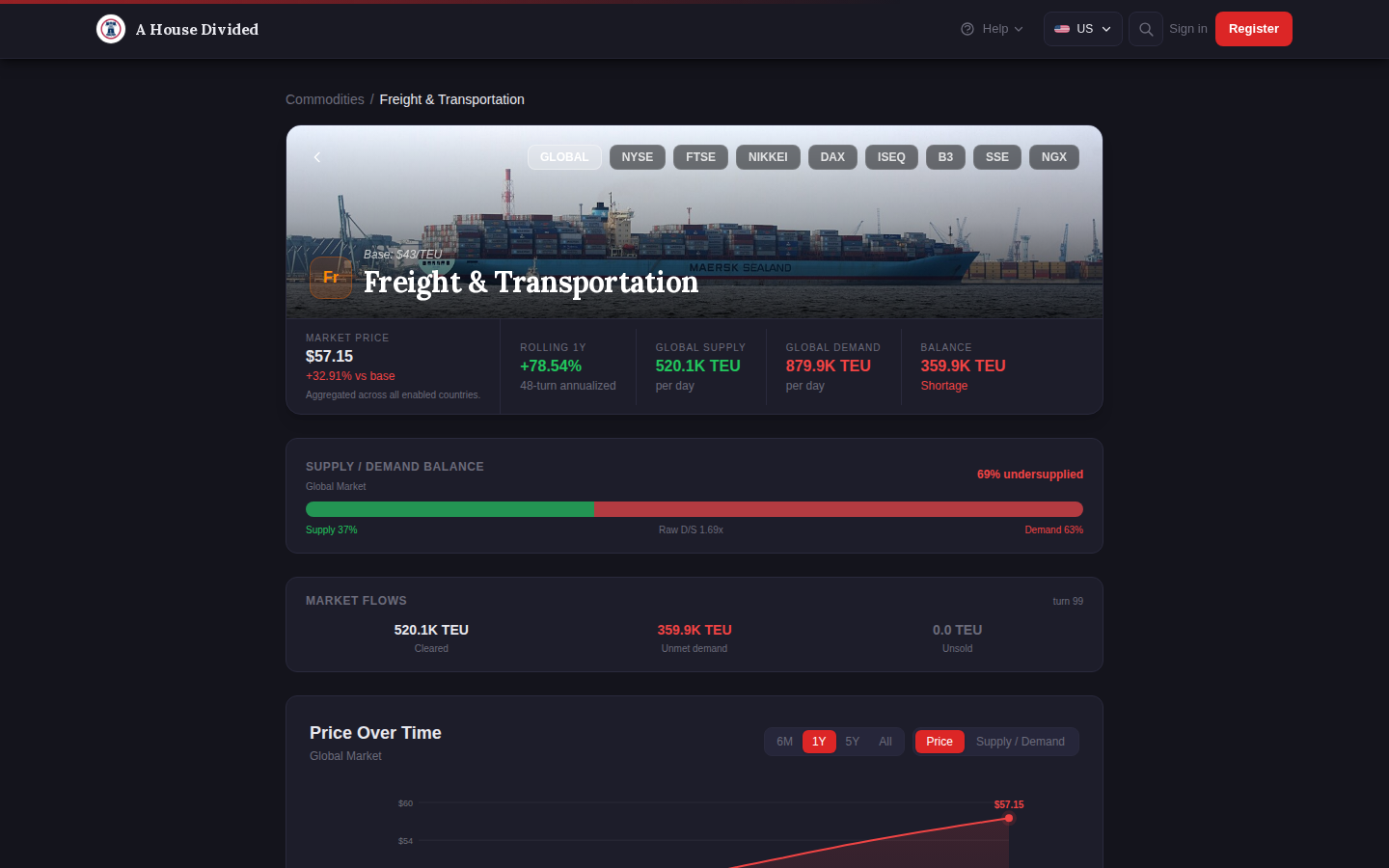
Read the page from top to bottom. First choose the market scope: Global or a country exchange. Then compare supply with demand, check how much volume cleared or stayed unmet, and only then use the price chart to decide whether the imbalance is new or persistent. A high price by itself is not a build signal if supply already exceeds demand.
Price history is retained for 5 game years (240 turns) and pruned automatically after that.
How commodity prices affect your corporation
Upstream shortages: If your sector requires Steel and the global steel D/S ratio rises to 2x, your manufacturing margin takes a -27.7% hit. Competitors who are vertically integrated (owning both a manufacturing and extraction sector) partially insulate themselves.
Downstream windfalls: If you are a steel producer and supply tightens, your extraction sector benefits from the shortage while your competitors suffer. Timing sector entries to commodity cycles can significantly boost profits.
Tariffs and the national tier: Tariffs don't change prices, but they shift how strongly each tier matters for margin calculations. The local (state) leg stays at 25%; tariff pressure moves weight from the global leg to the national leg. So a country with a 50% effective tariff sees 37.5% global / 37.5% national / 25% local instead of the no-tariff 50/25/25 split. A heavy-tariff country becomes much more sensitive to its own internal supply chain. See Tariffs for the full table and the foreign/domestic margin penalties tariffs apply on top of this.
Related systems
- Corporations: sector types, operating strategies, and profit margin mechanics
- Corporate R&D & Tech Trees: tech-tree unlocks and innovation breakthroughs
- Tariffs: how tariffs shift commodity blend weights and apply margin penalties
- National Budget: government spending that drives healthcare and real estate demand
- National Metrics: GDP growth that scales retail demand
- Logistics: Freight, Sourcing, and Supply Chains: freight demand, landed prices, and the Logistics map
- Planned / Command Economies - Administered national prices, shortage, and overhang when command economy is enabled